
What?
3EyedBear is a project of love by Dutch comic- and animation-designer Maarten Janssens. If you like to see more of his work, go check out his personal online studio-portfolio at buro-Lamp.

How?
Since 2005, Dutch comic-illustrator/designer Maarten Janssens has rediscovered the world of paper kits. His lifelong fascination with pictures, characters and paper-material came together in what soon became his project-of-love 3EyedBear. It still took two years before the project aired due to work and lack of direction, but in 07, Maarten launched his website which immediately became very successful.
The work still gets in the way, so the project is evening-, night- and weekendfueled but the direction appeared quite simple: It’s wrapped around the concept not only to create a basic and accessible awareness and little community for those who like papercraft, but mainly as an experiment to prove the philosophy that simple 3-dimensional ideas can travel as paperkits all around the world without cultural or natural boundaries. Because they translate easily into bits and bytes, you only need a computer, a printer, some scissors and glue to get started.
Mission Statement
Over here at the 3EyedBear coördination-center we take our craft seriously. It means that we test every paperkit untill it meets our highest standards.
We understand you papercutters and -folders out there very well, because we have blisters on our hands by building all the kits ourselves. Therefor we created internal guidelines for all of our engineers to follow.
Our golden rules are:
> Design to be made out of ordinary paper, with ordinary tools. People shouldn’t have to go to the craftshop before they are able to build our work.
> Always use special paper-size for the models with international paper-dimensions in mind.
> Take the paperkit-community seriously. No dumb kit or too stupidly complicated kit should reach the surface.
> A good kit should be do-able in about one hour maximum. Paperkit-people have more stuff on their mind and download a new one if not.
> Be sure the model is complete. Within the kit the specific manual should be attached.
> Be convinced the model uses as less expensive printer-cartridge-ink as possible
> Be aware that most printers do not print the whole paper-surface. The blanco edge should be at least 1 cm.
If there are more suggestions to improve our models quality, please leave a reply.

What is it about the process of designing and creating paper toys, and sharing these designs for free with the world that appeals to you?
The short answer would be that to me it’s the perfect threesome of paper, computer and internet, but let me explain.
First of all, paper is a very easy canvas to work on. It’s cheap, very accessible and always in stock anywhere. It comes in all kinds of sizes, colours, weights, structures and coatings. Even a child already ‘gets’ it. And with simple tools like scissors, knives, glue or tape, you can transform it in all kinds of shapes. Why work only on a flat surface? A 3D object tends to come alive, you can walk around it, name it, hold it and place it where you think it feels home. When you think about it, a flat picture just masks the dirty spot on your wall ![]()
With a background of being a comic- and animation-designer, I’m used to work with paper, although nowadays I hardly touch it because all the work gets done into the computer. And rightfully so: a lot of exciting developments have happened since then. With the (r)evolution of video-games and computer-animation, I’m brought up seeing characters and worlds being created out of shapes wearing skins. And with my paper mindset, consisting of love for packaging, origami and pop-up-worlds, it was a small step to experimenting with simple shapes like boxes, cones, tubes or pyramids and combining these shapes into even more complex new shapes.
The computer plays an essential part also. You just create something, hit the print-button of the printer and you’ll have your piece of art ready for framing. And another one or yet another one, since the printer is basically your cheap home copying-machine. That’s very appealing obviously, because the original piece of art, conceptual mainly, belongs and stays with you. But you can share it with an unlimited audience in your own little online gallery. Just create interesting stuff and people will come see it. Or give away happy little stuff, that always helps ![]()
Also, the computer translates your work into an international language of bits and bytes, which can be ‘shipped’ throughout the world with the speed of light. Nifty
It’s like beaming up stuff from StarTrek (hey, it’s my upbringing
if you, as I do, forget about the tiny little fact that the toy arrives as a deformed, flat, needing to be re-build package. But I’m sure some brainiacs are figuring that one out already
And no-one has complained yet really. I’m already very happy that I don’t need sweatshop-factories, money-scraping and corrupt bosses, sweet-talking middle-men, foulmouthed truck-drivers, well a lot of money basically to get my stuff to the other side of the world. I Do It Myself. From behind this little humble humming machine.
And then there’s internet. I love it! It’s truly democratic, it stimulates human communication and because of the sharing of ideas: creativity. And internet is everywhere: I’ve traveled a lot and have been in truly far away places, but I always was able to stay in touch with my parents, even if I was Skyping from a little shack deep in the jungle. Really. You see the poorest slum-village to discover satellite discs on top of the roofs. It’s 2009 baby ![]()
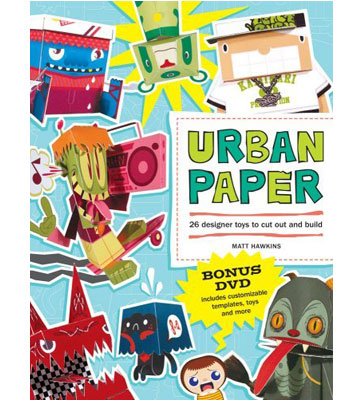
And so it happens that I get e-mails from these places with questions, feedback and photo’s of my toys. I’ve seen Sofia standing on the mighty MachuPichu and 3EyedBear in front of the jaw-breaking TajMahal. I’ve received custom-designs from Colombia and Indonesia. And, with the book ‘Urban Paper’ recently released, we have exhibitions on three continents. They just ask for permission to print out your toy and place it in a gallery.
It’s truly becoming a small world, because the internet has no physical boundaries. You ‘meet’ a lot of creative people who join forces with the customizing part of the toys. They study each others creations and interpreted it from their own perspectives. And we communicate with a world-audience who give you feedback and critique on what you create. They stimulate us to work and think harder the next time.
Well, to me it’s creative, communicative, exhilarating and rewarding. It’s kind of magic ![]()
And of course it’s free. I cannot blame the internet for the same reason I’m loving it. I could sell a model and the next day somebody distributes it, out of my sight and control, for free anyway. The rent is being paid with commissions and special projects. Nobody ever notices. Oh, and my day-job apparently
More online interviews:
>2011> Eigenwerk (German)
>2010> Papertoys (Portuguese/English)
>2009> Fontanel (Dutch)
>2007> ToysREvil (English)


liz
on Apr 24th, 2011
@ 4:31 pm:
i’ve been pretty inspired by you guys. blogged here, if you’re interested. http://thehandmadewagon.blogspot.com/2011/04/thought.html
thanks for sharing the love of your craft!